
Hardware & NetworkingResearch Note
Li-Fi in 2026: Where Is the Technology Now?
An evidence-led look at optical wireless communication, IEEE standardization, practical constraints, hybrid Wi-Fi designs, and the niches where Li-Fi may matter.
Li-Fi has spent years caught between impressive laboratory demonstrations and the recurring claim that light will replace Wi-Fi. In 2026, neither extreme is a useful description. Optical wireless communication is a standardized and active field with real engineering advantages, but it remains constrained by coverage, mobility, device integration, and the need for an uplink.
The better question is not whether Li-Fi defeated Wi-Fi. It is where an optical link solves a problem that radio does not solve as cleanly.
Li-Fi is part of a broader optical field
Li-Fi commonly refers to bidirectional, networked wireless communication using light rather than radio frequency. Visible light can carry data, but optical wireless also includes infrared and other optical bands. That broader definition matters because a practical system may use visible light for a downlink, infrared for an uplink, or non-visible light for both directions.
Data is encoded by modulating an optical transmitter quickly enough that ordinary illumination does not visibly flicker. A receiver detects changes in the light and recovers the signal. The exact physical layer can vary; Li-Fi should not be reduced to the idea of an LED bulb blinking binary data.
The technology also sits within standards work rather than existing only as a collection of demonstrations. IEEE 802.11bb, approved in 2023, amended the 802.11 family to support light communications. ITU-T G.9991 specifies a high-speed indoor visible-light communication transceiver. IEEE's active P802.11br project is developing further enhanced light communications work, evidence that standardization is continuing rather than finished.
Laboratory speed is not room-scale performance
Optical communication research can report very high data rates under controlled conditions. Those results matter: they show what transmitters, receivers, modulation, optics, and signal processing can achieve. They do not automatically describe a mobile device moving through a furnished room under sunlight and artificial lighting.
Practical performance depends on optical power, receiver area and orientation, distance, field of view, ambient light, reflection, modulation bandwidth, and the capacity shared among users. A laboratory link with carefully aligned equipment answers a different question from a deployable network with coverage and mobility requirements.
This distinction is not a criticism of research. It is the normal path from a physical-layer result to a usable system. Claims should state which level they describe.
Light changes the shape of coverage
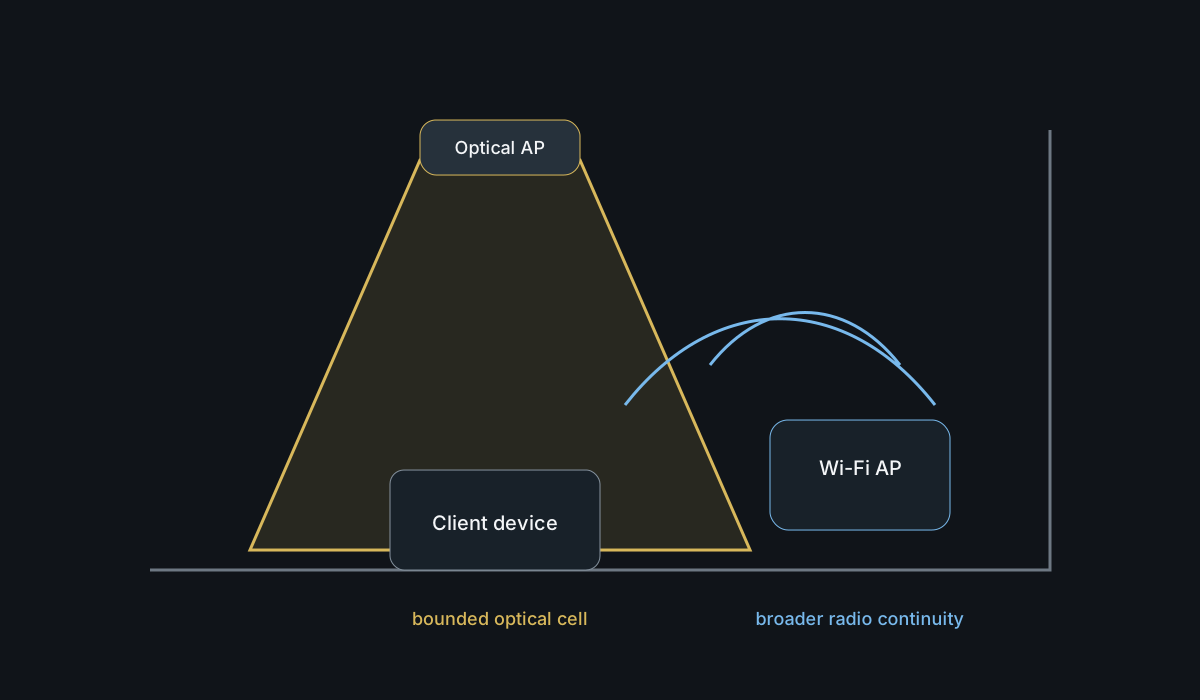
Radio passes through many ordinary interior materials; light generally does not pass through opaque walls. That can make optical cells spatially bounded. A room or illuminated zone can reuse optical spectrum without creating the same radio interference pattern in adjacent spaces. It can also reduce signal leakage beyond a physical boundary.
The same property creates a deployment challenge. Blocking or shadowing the direct path can weaken a link. Reflections may support non-line-of-sight operation, but with different power and performance. Receiver orientation matters, particularly on mobile devices. Coverage has to account for people, furniture, daylight, dimming, and devices moving between light cells.
Security language needs similar care. A signal that does not penetrate a wall can reduce some eavesdropping opportunities. Windows, doorways, reflections, compromised endpoints, and network infrastructure still exist. A bounded medium is a useful security characteristic, not a replacement for authentication and encryption.
The uplink is an engineering decision
A bright luminaire can be an effective downlink transmitter, but a phone or sensor does not necessarily have an equally capable visible-light transmitter pointed at the ceiling. Uplink design may use infrared, another optical source, or radio. Each choice affects power use, coverage, eye-safety constraints, hardware, and coexistence.
This is one reason hybrid systems are more realistic than replacement narratives. Research on hybrid Li-Fi and Wi-Fi networks studies load balancing, handover, resource allocation, and link selection across optical and radio access. Wi-Fi can provide continuity and broad coverage; Li-Fi can add capacity or a useful bounded channel in suitable spaces.
A hybrid network is not automatically simpler. It needs decisions about when devices move between links, how sessions persist, how capacity is allocated, and how users behave near the edge of an optical cell. But it frames the technologies as complementary tools.
Where the constraints can become advantages
Li-Fi is most interesting where its physical characteristics align with a specific environment. Potential niches include spaces with difficult radio-frequency constraints, dense indoor capacity needs, locations that benefit from bounded coverage, industrial areas where electromagnetic compatibility matters, and positioning or communication systems that can use existing lighting infrastructure.
Each niche still requires verification. “RF-sensitive” does not mean optical equipment is automatically approved. An aircraft cabin, hospital room, factory, classroom, or secure facility has different safety, maintenance, mobility, and integration requirements. The business case depends on devices and infrastructure as much as link speed.
Consumer adoption has an additional dependency: receivers and transmitters must appear in ordinary devices without unacceptable cost, power, size, or design compromises. A network technology cannot become routine if every user needs an unusual external adapter.
Why it has not replaced Wi-Fi
Wi-Fi benefits from mature silicon, widespread device support, broad coverage, familiar deployment practices, and continuous standards development. Radio works when lights are off and around many obstacles that interrupt optical paths. Those are powerful practical advantages.
Li-Fi has not made those properties irrelevant. Its standards progress creates a better base for interoperability, but standards are only one part of an ecosystem. Cost, installation, client hardware, management tools, and reliable mobility determine whether a technology leaves the lab.
Replacement was probably the wrong test from the beginning. Ethernet did not disappear when Wi-Fi became common, and private cellular does not make Wi-Fi pointless. Networks combine media when their properties solve different requirements.
What would make Li-Fi more relevant
Several developments would change the practical calculation: integrated client hardware; easier multi-vendor deployment; predictable handover between optical and radio links; clearer operational tooling; compelling high-density or RF-constrained use cases; and evidence from sustained real deployments rather than peak demonstrations.
Continued IEEE work is worth watching because it can improve common technical foundations. Research into hybrid resource management, mobility, optical components, and non-line-of-sight performance is equally important. Progress will probably look less like one dramatic Wi-Fi replacement and more like optical links appearing where their bounded coverage, spectrum, or environmental properties are genuinely useful.
In 2026, Li-Fi is neither imaginary nor inevitable. It is a specialized wireless medium becoming more standardized, with a credible role alongside radio if its deployment and device problems are solved for the environment at hand.
Sources & further reading
- IEEE 802.11 Working Group project timelines — IEEE 802.11
- Task Group bb status — IEEE 802.11
- IEEE 802.11bb approved by the IEEE-SA Standards Board — IEEE 802.11
- Enhanced Light Communications amendment project — IEEE Standards Association
- High-speed indoor visible light communication transceiver — System architecture, physical layer and data link layer specification — ITU-T
- A Survey of Hybrid LiFi and WiFi Networks — IEEE Access / PubMed Central