
AI & Emerging TechnologyExplainer
Open-Weight AI: When Does Running Your Own Model Make Sense?
A decision framework for local and self-hosted AI that separates downloadable weights from open source and weighs privacy, control, cost, hardware, and operations.
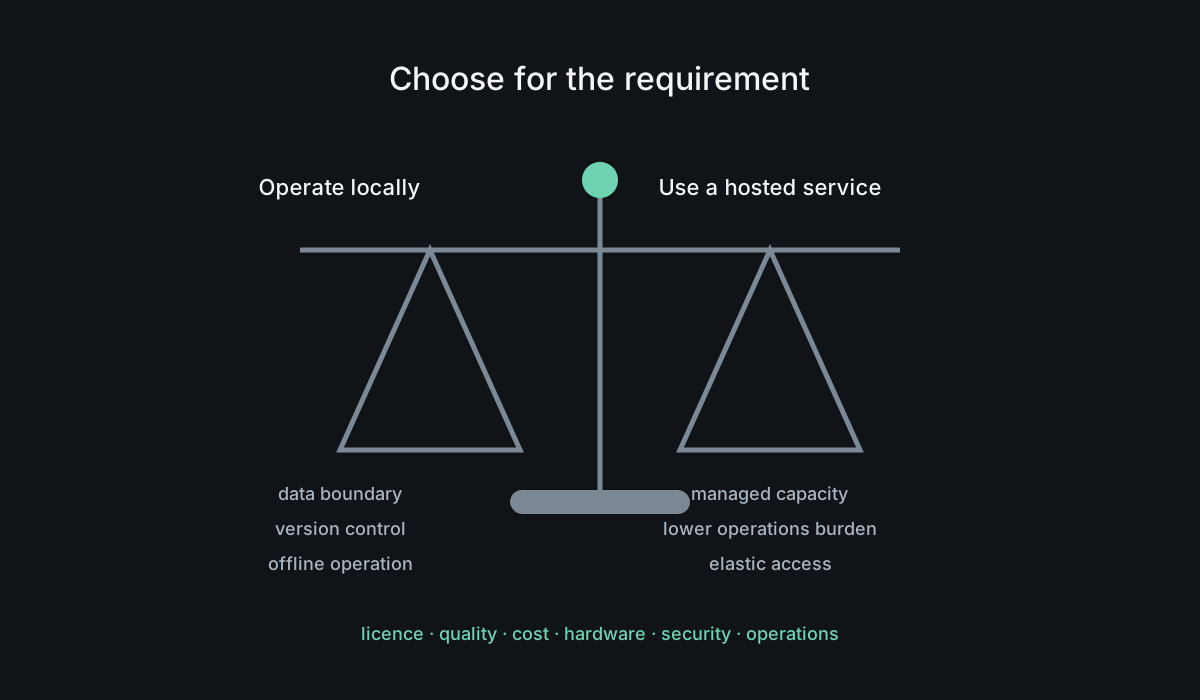
Downloading a model feels like taking control. The files are on your hardware, prompts can remain on your network, and an external API is no longer in the critical path. Those are real advantages. They do not, by themselves, make the model open source—or make self-hosting the right engineering choice.
The useful question is not “Can this model run locally?” It is “Which requirement becomes easier to satisfy when we operate it ourselves, and is that benefit worth the new responsibility?”
This article reflects the ecosystem as of August 2026, but avoids model rankings because they age quickly. Licenses, model cards, hardware requirements, and vendor terms should always be checked for the exact release under consideration.
Open-weight is not automatically open source
An open-weight model makes trained parameters available under some licence. That can enable local inference and, depending on the release, fine-tuning or redistribution. It does not necessarily provide the training code, data information, or freedoms needed to study and modify the full system.
The Open Source Initiative's Open Source AI Definition describes freedoms to use, study, modify, and share an AI system, along with access to the preferred form for making modifications. Its separate discussion of open weights explains why access to parameters alone is a narrower property.
The distinction matters operationally. Two downloadable models may impose different restrictions on commercial use, user scale, redistribution, acceptable uses, or derivative models. “Available on a model hub” is not a licence category. The relevant licence and model card must be reviewed for the specific version.
Privacy improves only if the system around the model does
Local inference can keep prompts and retrieved documents away from an external model API. That is valuable when data residency, contractual restrictions, disconnected operation, or a tightly controlled processing boundary is a real requirement.
But local does not mean private by default. Applications may log prompts. Vector databases may retain sensitive fragments. Telemetry, package downloads, backups, crash reports, and administrative access can create other paths out. A model server exposed without authentication is not a privacy strategy.
The complete data flow matters: collection, prompt construction, retrieval, inference, logs, output storage, backups, deletion, and human access. NIST's AI Risk Management Framework and Generative AI Profile are useful precisely because they treat risk as a system and governance problem, not a single deployment toggle.
Control comes with an operations bill
Self-hosting provides control over version changes, availability windows, network boundaries, model selection, and some forms of customization. It can also make an application independent of a provider's rate limits or API changes.
That control transfers work to the operator. Someone must choose and validate a model, obtain it from a trusted source, track licences, patch the serving stack, monitor capacity, restrict access, rotate dependencies, evaluate updates, and recover from failure. Model behaviour must be tested against the real task, not inferred from a leaderboard.
Hardware is part of the design. Parameter count is only a rough indicator. Precision, quantization, context length, concurrent users, batching, memory bandwidth, and the serving runtime all affect latency and capacity. A model that fits in memory may still be too slow under the required workload.
Cost depends on utilization
Hosted APIs turn much of the cost into usage. Self-hosting turns it into hardware or cloud capacity plus engineering time. A machine already available for a steady, predictable workload can make local inference economical. Expensive accelerators sitting idle can make the same decision wasteful.
The comparison should include:
- acquisition or rental of compute;
- power, cooling, storage, and networking where relevant;
- operational labour and monitoring;
- redundancy and recovery expectations;
- evaluation work after model or application changes;
- hosted API charges at realistic volumes.
It should also value constraints that do not fit neatly into a cost-per-token calculation. Offline operation or a hard data boundary may justify a higher direct cost. Conversely, avoiding infrastructure work may be the best use of a small team's time.
Security changes shape rather than disappearing
A hosted provider creates supply-chain, account, data-handling, and service-dependency risks. A local deployment reduces some of them and introduces others: malicious or tampered model artifacts, vulnerable inference servers, overly permissive endpoints, unsafe generated actions, exposed management interfaces, and unreviewed dependencies.
Model output remains untrusted input to downstream systems. Running the weights locally does not make prompt injection, data leakage through retrieval, insecure tool use, or hallucinated instructions disappear. If a model can call tools, the tool permissions and approval boundaries matter more than where inference occurs.
Updates require judgment too. Keeping a fixed version supports reproducibility, but leaves known limitations in place. Updating may improve quality or security while changing behaviour. A sensible process keeps model and runtime versions explicit, evaluates representative tasks, documents licence changes, and provides rollback.
When local inference genuinely helps
Running an open-weight model makes sense when one or more requirements are strong enough to justify ownership of the stack. Examples include a disconnected environment; sensitive data that cannot be sent to an external processor; predictable high utilization; a need to pin and validate a specific model version; specialized customization; or latency that materially improves when inference is close to the application.
It is less compelling when the workload is small or irregular, the team lacks time to operate accelerators and serving software, the best task quality comes from a hosted model, or provider-managed safeguards and compliance features solve more risk than local deployment removes.
A hybrid design is often reasonable. Sensitive classification might run locally while a hosted model handles public-content drafting. A small local model might route work, with difficult cases sent to a stronger service under an approved data policy. Architecture can follow data and quality requirements instead of ideology.
A conditional conclusion
Open weights expand what individuals and organizations can inspect, adapt, and operate. That is important. Yet “local” is not a synonym for private, secure, cheap, or open source.
The strongest reason to self-host is a specific requirement that self-hosting satisfies better than the alternatives. If that requirement survives a full accounting of licensing, data flow, hardware, security, evaluation, and operations, local AI can be a sound engineering decision. If it does not, a hosted service may be the more controlled choice—even when downloading a model is easy.
Sources & further reading
- The Open Source AI Definition 1.0 — Open Source Initiative
- Open Weights — Open Source Initiative
- Artificial Intelligence Risk Management Framework — NIST
- Artificial Intelligence Risk Management Framework—Generative AI Profile — NIST
- Llama 4 model card — Meta
- Under which license are Mistral's open models available? — Mistral AI